Why the Same Meal Costs More on a Delivery App — Saudi Market Numbers and What You Can Do
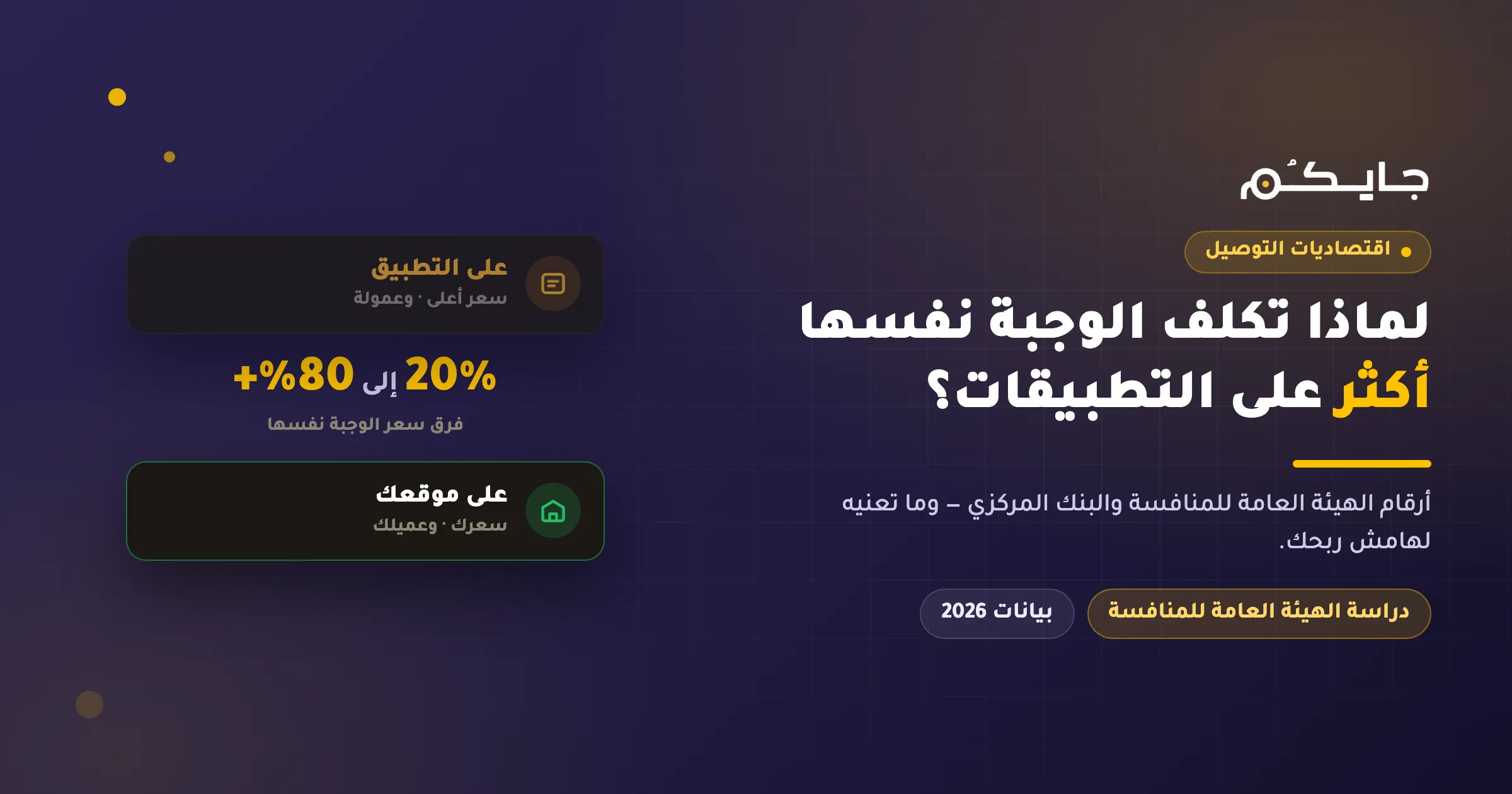
In short: a General Authority for Competition study — reported by Argaam — found price differences on the same meal ranging from around 20% to more than 80% between delivery apps and restaurants’ own direct prices. That gap does not reach the restaurant; it is the cost of the channel. Owning a direct ordering channel is the only way to recover that margin and your customer data.
Delivery apps are not the enemy. They generate real demand and bring in new customers. But depending on them alone is an expensive decision, and the published numbers show exactly how expensive.
First: how big the channel is in Saudi Arabia
It is large and growing fast:
- Delivery app sales rose from SAR 2.8 billion in 2018 to SAR 16.2 billion in 2023, lifting their share of the food services market from 3.5% to 14.4% — out of a total market of SAR 112.5 billion in 2023.
- Order volume grew from 228 million orders in 2023 to 290 million in 2024 and 408 million in 2025 — 79% growth in two years.
Source: General Authority for Competition study, via Argaam
Second: what the commission actually is
The most reliable figures come from a listed company that discloses its results. Jahez disclosed in its FY2024 results that its take rate improved from 13.5% in 2023 to 14.6% in 2024. In its FY2025 results, commission revenue was SAR 1,113.8 million against GMV of SAR 7.2 billion.
A caution: “take rate” is not necessarily the commission percentage in your specific contract — it bundles other revenue lines. But it gives you a realistic order of magnitude for the cost of the channel instead of guesswork.
Sources: Jahez FY2024 results · FY2025 results
Third: the price gap your customer pays
This is the number that matters most. The General Authority for Competition study found differences on the same meal ranging from around 20% to more than 80% between apps and restaurants’ direct prices.
Put plainly: your customer pays more, and you do not collect the difference.
The study also noted that below-cost pricing by some platforms caused significant financial damage to restaurants, compounded by delays in the disbursement of their dues.
Fourth: what the competition authority is proposing
The Authority published a draft guide for food delivery platforms on the Istitlaa public consultation platform. Its main points include:
- A platform may be treated as dominant once its market share reaches 25%, measured by annual order volume using Transport General Authority data.
- Price parity (MFN) clauses — requiring a restaurant not to offer a better price on another channel — are listed among practices prohibited for dominant platforms, including the “wide” form that stops a restaurant offering a better price even on its own channel.
- Differing commission rates between one restaurant and another are listed as a prohibited form of discrimination.
- Using a commission increase, or withdrawal of a commission discount, to enforce exclusivity is listed among prohibited practices.
Important — legal status: this is a draft issued for public consultation and has not been adopted. Its text grants a four-month corrective period from the date of adoption — and that clock has not started, because adoption has not happened. Do not base a contractual decision on it being in force today; but it clearly signals the direction of regulation.
Source: General Authority for Competition — draft guide on competition in food delivery platforms (Istitlaa)
Fifth: what these numbers mean for your restaurant
Saudi Central Bank data adds an important angle. In the week of 16–22 August 2026, restaurants and cafés recorded 56.77 million POS transactions worth SAR 1.668 billion — about 24% of all POS transactions in the Kingdom by count, but only 11.8% by value.
The result: an average restaurant ticket of about SAR 29.38, against an all-activity average of SAR 59.72.
Source: Saudi Central Bank — Weekly Point of Sale Transactions
And that is the crux of it: a sector operating on an average ticket under SAR 30 cannot absorb a double-digit percentage taken out of every order. When your average order is small, commission stops being a cost line and becomes the difference between profit and loss.
Sixth: the answer is not withdrawal — it is channel balance
The common mistake is thinking in terms of “apps or nothing”. The best-performing restaurants run two channels:
- The apps for discovery and one-off ordering moments.
- Your own channel for repeat customers — who are the most profitable ones.
In practice, when the same customer orders for the third time, there is no commercial reason for that order to pass through a middleman who takes a cut of every order and keeps the customer relationship.
What your own channel needs to work
- An ordering site in your name — a digital menu and direct ordering, with your prices and your branding.
- A delivery solution — your own drivers, or a logistics partner such as QMile that delivers your site’s orders with no commission on order value. We walk through the full cycle in the guide to accepting delivery orders through QMile.
- A reason for customers to come back directly — a better price, an exclusive item, or simply telling them the site exists.
- A Balady home delivery permit — mandatory since 1 July 2025 for anyone offering delivery. See home delivery requirements for restaurants.
FAQ
Can I offer a lower price on my own site than on the apps? That depends on your contract with the platform. Some contracts include price parity clauses — the very clauses the General Authority for Competition listed among practices prohibited for dominant platforms in its draft guide. Read your contract first, and take legal advice before changing your pricing.
So should I drop the apps? No. Apps are an effective discovery channel. The goal is that they are not your only channel, and that your repeat customers do not have to go through them.
What does my own channel cost? It varies by provider. With Jaicome there is no commission on the value of an order placed on your site; order-processing fees and online payment gateway fees apply.
Why does customer data matter? It is a commercial asset. Without it you cannot identify your repeat customers, contact them, or measure whether a promotion worked. Through an app, that relationship is not yours.
Is delivery demand growing or shrinking? Growing — 408 million orders in 2025 against 228 million in 2023, per the Authority’s study. The question is not whether to offer delivery, but through which channel.
Start with your own channel
You do not have to choose between growth and margin. Build a digital menu and commission-free ordering site with Jaicome, switch on delivery from the Add-ons Store, and keep your customers and their data.